
UF Law E-Discovery Conference · Since 2012
About the conference
The Practical E-Discovery Conference.
Education that changes how you work.
Good education changes how you work. The UF Law E-Discovery Conference brings people together to explore the questions, challenges, and possibilities shaping e-discovery, legal technology, and the use of legal data.
Through candid conversations, practical panels, and shared resources, attendees gain approaches they can use immediately and professional relationships they can build on throughout the year.
Florida roots · International reach
A growing global community.
Founded by Professor William Hamilton and EDRM Founder George Socha, the conference began as a small, Florida-focused hybrid event. Over the past 15 years, it has grown into an international gathering while keeping practical education and access at its center.
Based on 2026 registration and platform data. Countries and territories reflect participants’ connection locations.
Recent registration growth
Nearly 3.7× the 2024 total.
Growing participation reflects a community that now reaches across organizations, career stages, and borders.
Practical by design
Ideas you can put to work.
The conference connects legal principles with the decisions people make every day. Judges, attorneys, technologists, educators, and other professionals bring different perspectives to the same practical questions: What works? What is changing? How can we improve?
Attendees leave with practical approaches, best practices, templates and resources, new ideas to explore with their teams, and people they can turn to as questions arise.
“The UF Law eDiscovery Conference has quickly moved to the top of my list for hands-on real-world education.”
Stephanie Clerkin (opens in a new tab)Director of Litigation Support, Korein Tillery · Conference speaker · 2024
Who attends
A place for everyone who works with legal data.
Whether you are learning the fundamentals, managing complex matters, or leading a team, there is a place for you here.
Legal practitioners
Attorneys, judges, general counsel offices, in-house legal teams, and government lawyers.
Discovery and litigation teams
Paralegals, litigation support professionals, e-discovery practitioners, consultants, and technology providers.
Data and operations professionals
Legal operations, information governance, privacy, compliance, investigations, and the broader Legal Data Intelligence community.
The next generation
Law students, paralegal students, educators, and professionals entering the field.
Different roles bring different questions. Learning together helps us understand how our work connects and how we can support one another.
Perspectives across the profession
Trusted across the profession.
Judicial perspective“This is an excellent public service by the University of Florida Law School, as the Conference advances e-discovery knowledge in our federal and state courts.”
U.S. Magistrate Judge William MatthewmanConference speaker · 2022
Legal leadership“This is one of the best substantive conferences in the United States. The quality of the panelists is impressive. I learn so much at this conference every year.”
Kenya Parrish Dixon (opens in a new tab)Partner, Nelson Mullins · Conference speaker · 2022
Access is part of the mission
Virtual from the beginning.
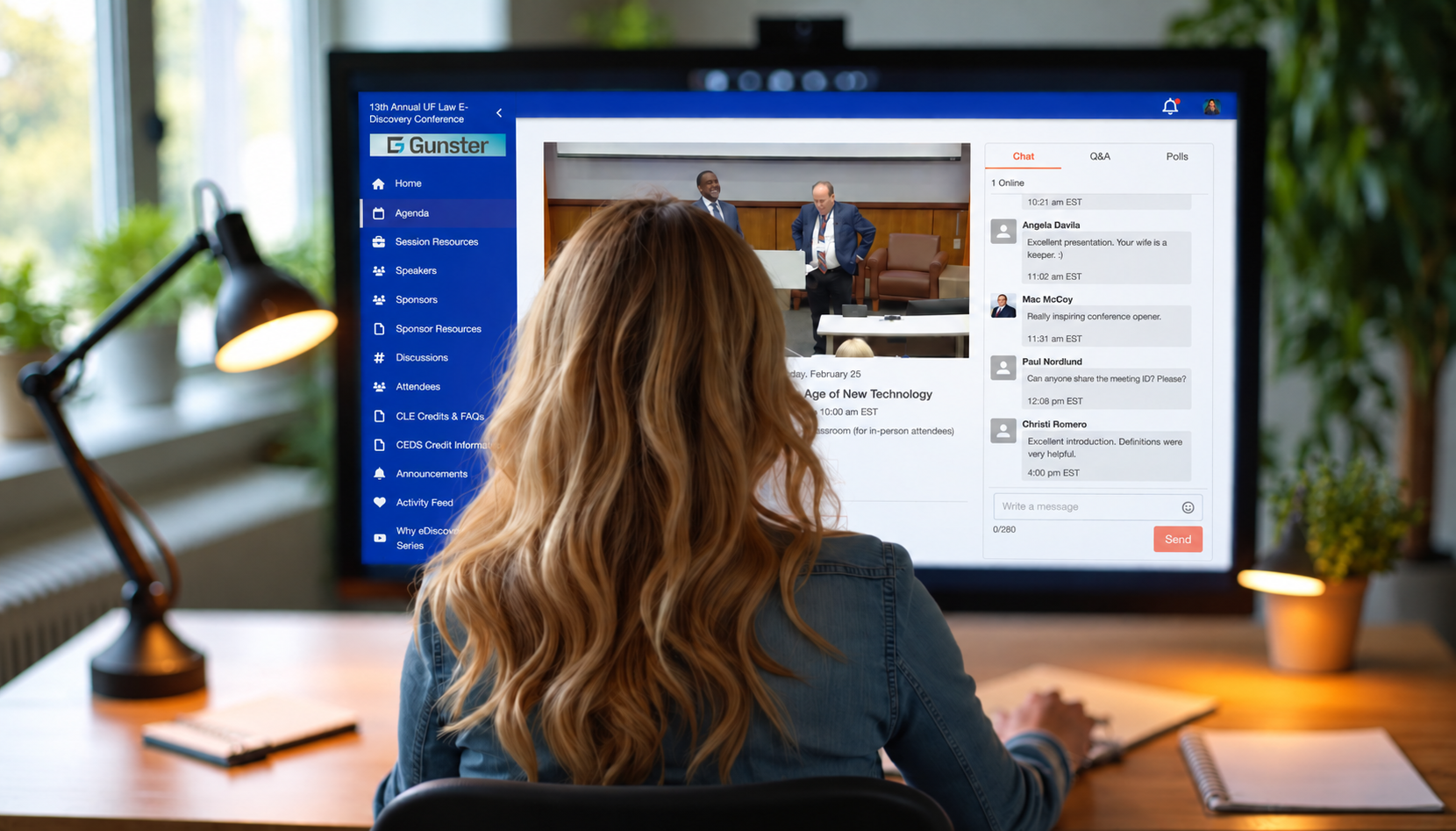
Virtual attendance has been central to the conference since its inception, and it will remain central as the conference grows. It opens participation to people who may not be able to travel and connects professionals across locations and time zones.
Join virtually from your own workspace or attend in person in Gainesville. Both are part of the same conference community.
“The UF Law eDiscovery Conference is a one-of-a-kind eDiscovery conference that provides a content rich and engaging format for both virtual and in-person participants.”
Jennifer Joyce · Conference speaker, 2024
Beyond the event
The conversation continues.
In 2026, the University of Florida’s Journal of Technology Law & Policy published a special e-discovery issue in partnership with the 13th annual conference, extending the conversation through scholarship on AI, discovery, and the courts.
Read the 2026 special issue (PDF opens in a new tab)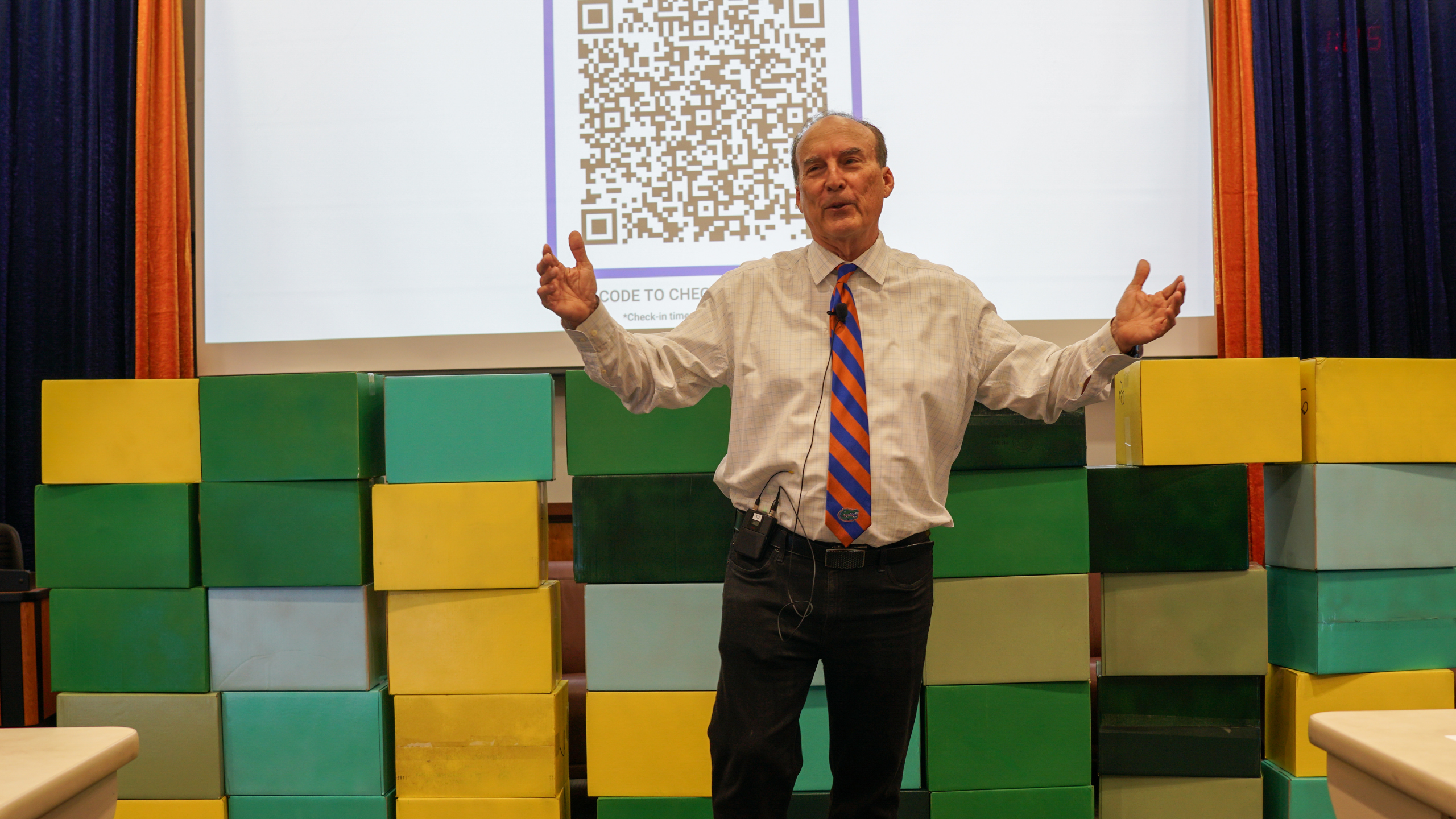
From the founder
Why the conference began.
Professor William Hamilton · Founder and Planning Committee Chair
“I could teach only so many students, but a conference could reach far more people.”
When I started teaching e-discovery at UF in 2008, I viewed it as a survival course. The traditional apprenticeship model had been reversed: my students often graduated knowing more about e-discovery than the firms that hired them. That inversion sparked the idea for the conference.
The idea grew out of several converging experiences, beginning with my own practice. In 1996, I designed and launched Holland & Knight’s website at hklaw.com (opens in a new tab). My practice later evolved into class action defense in the telecommunications industry, so I was doing what we now call e-discovery in the late 1990s and early 2000s, before the field even had a name.
Around 2005, Holland & Knight asked me to develop a three-month luncheon series to teach the firm’s lawyers e-discovery. It struck me that no one was teaching e-discovery to law students at UF, and most of them would not join firms with in-house programs like the one I had built. So I began teaching at UF as an adjunct in 2008, a position I held while maintaining a full-time litigation practice. It was the start of 10 years of driving to Gainesville every Monday during the semester to teach e-discovery as an adjunct.
By 2011, things had not dramatically improved despite the impact of important case law and the work of the Sedona Conference and EDRM. It is hard now to remember how low the level of competence was. I repeatedly saw attorneys and paralegals who believed that what appeared on the screen was something stored inside the computer, like a page in a file cabinet, rather than a rendering that software assembled on demand from digital files, ultimately strings of ones and zeros interpreted by applications. The information container had changed, and many lawyers had not noticed. Judges were left to referee disputes between attorneys who did not understand that the game had changed.
The rules of civil procedure were written for paper, and judges and lawyers, especially in state courts, were still trying to shoehorn this new kind of information into them. Very few knew how to do it in a practical way. The results were serious mistakes, errors, and too often, game-playing, because a lawyer who understood the technology could exploit an opponent or a judge who didn’t. In the years after Zubulake, attorneys handled e-discovery willy-nilly and learned as best they could on the fly.
I could teach only so many students, but a conference could reach far more people. I was also concerned that judges and government attorneys had almost no practical educational resources. So George Socha, founder of the EDRM, and I developed the idea of a conference as a public service to raise e-discovery competence outside the classroom, providing practical takeaways that attendees could use the day after the conference.
We decided it should be hosted by a trusted educational institution with no financial interest in the outcome, a deliberate choice in a field crowded with vendor-sponsored events. No pay-to-play or self-promotion in any of the conference sessions. From the start, we also knew the conference’s reach had to extend beyond campus, so we began experimenting with innovative ways to reach and involve what we now call “online” audiences.
We also wanted the conference to be broad and to include all the players: e-discovery technicians, e-discovery professionals, paralegals, and attorneys. The goal was a common, basic understanding that would enable firms to talk among themselves, with their clients, and with the courts. Attorneys feared software and data, and even as late as 2011, that fear remained a major obstacle. We needed to make attorneys and paralegals comfortable working with the technology.
The approach was deliberately practical. The work of organizations such as the Sedona Conference and EDRM was valuable, but it was not reaching every practitioner. We wanted to bring the entire industry together to build shared understanding and skills.
The response was immediate, and the conference quickly became a success. The industry jumped in. Volunteers came from the judicial system, think tanks, law firms, and vendors, all eager to help. Everyone volunteered, and the University hosted the conference as a public service. That outpouring confirmed that the need was real and that the whole community wanted a place to meet on neutral ground.
Built by the community
Meet the people behind the program.
Led by founder and chair Professor William Hamilton, our planning committee turns the questions facing the profession into the conference program. Members contribute panel ideas, practical resources, and perspectives from across the legal and technology communities.
Meet the planning committeeThe 14th annual conference
Join us in 2027.
February 10–11, 2027 · Virtual pre-conference February 9
Explore the 2027 conference